The L0 does not touch the track at all! Below about 150 km/h it rolls on rubber wheels, then superconducting magnets lift it roughly 10 cm and it flies along inside a U-shaped concrete trough. In 2015 it reached 603 km/h with people on board, the fastest a manned railway vehicle has ever gone. Everyday Chuo Shinkansen journeys are planned at about 500 km/h, and the line has not opened yet.
Speed
375mph603 km/hWorld record · manned rail vehicle, 21 April 2015
Year
2013First L0 units on the test line
Maker
Mitsubishi Heavy Industries & Nippon Sharyo
Job
Testing the future Chuo Shinkansen
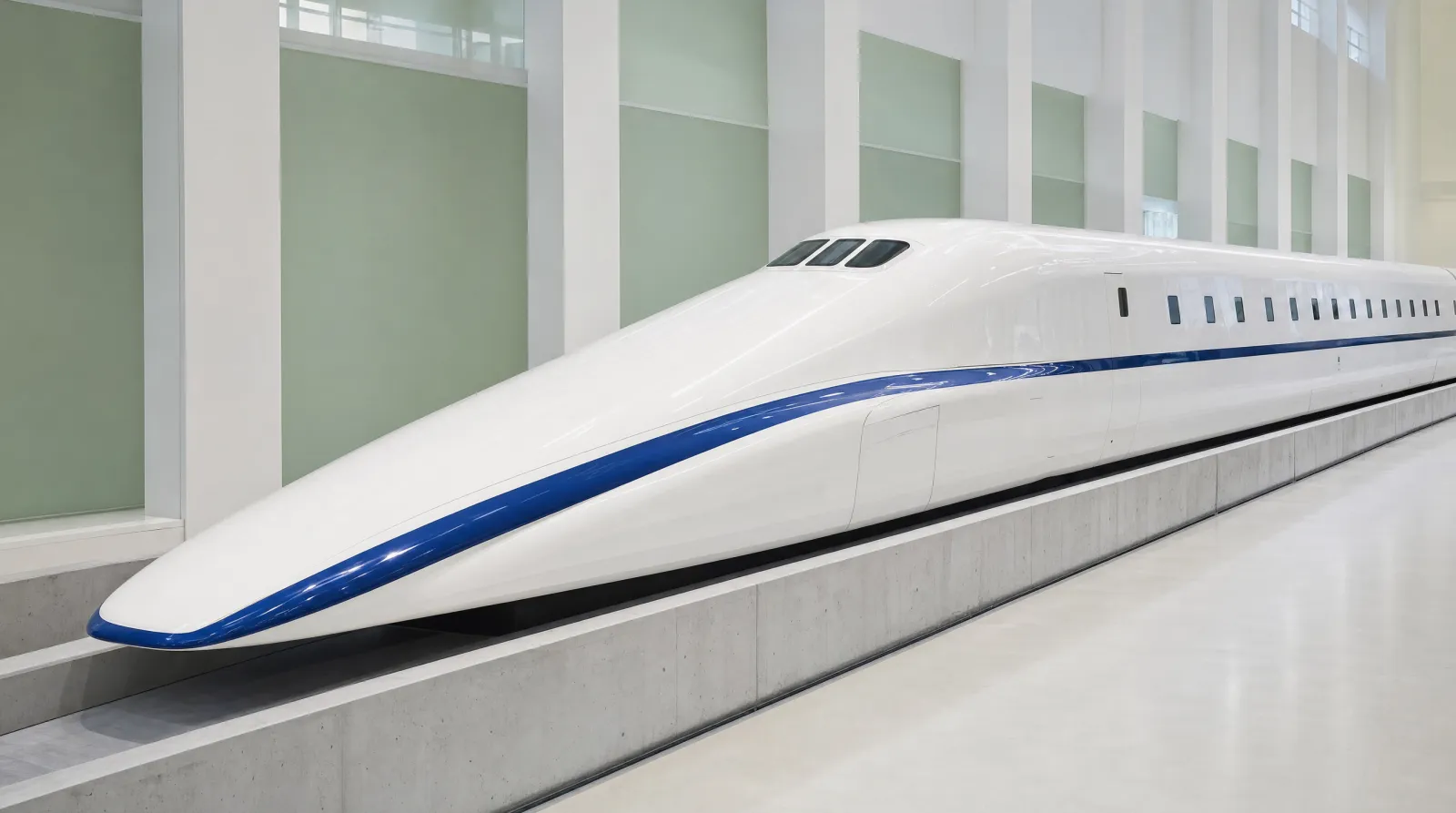
Train portrait · illustrated learning model
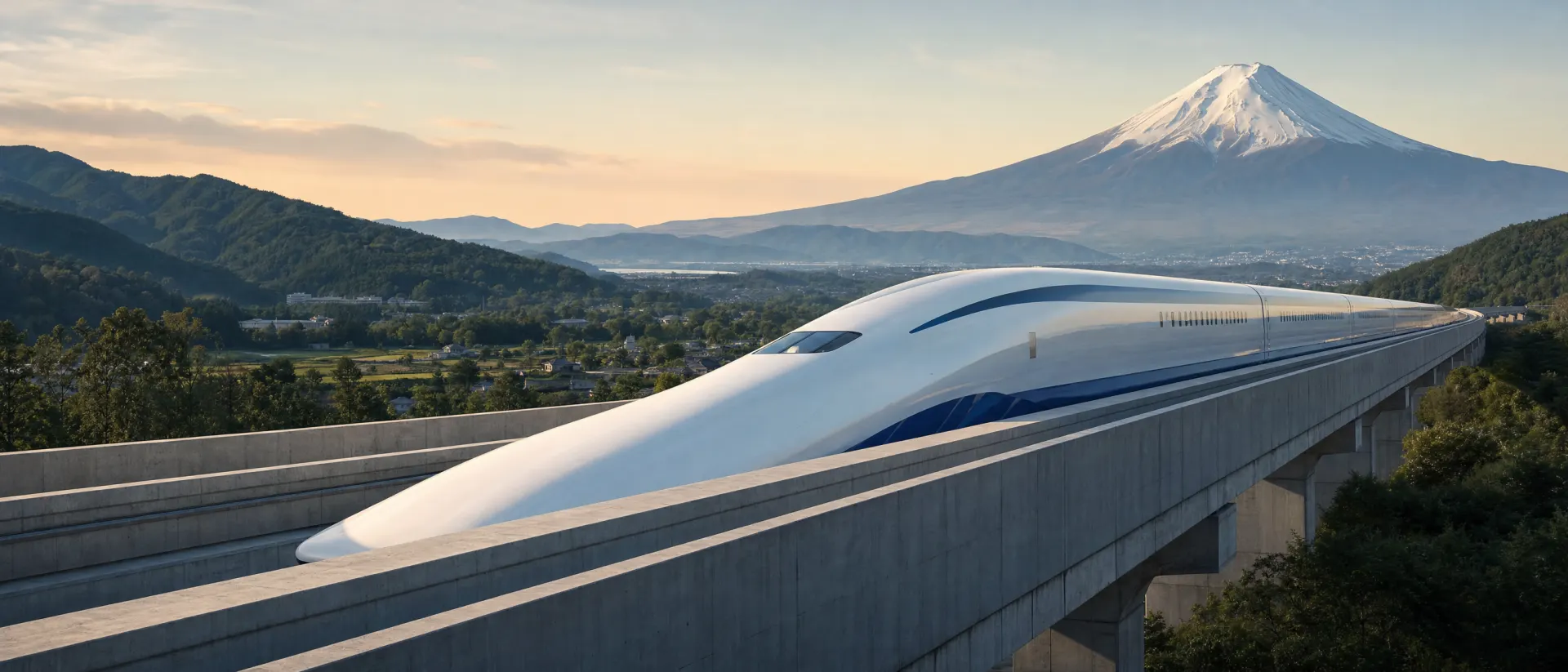
L0 Series on its guideway · illustrated learning view, with Mount Fuji behind the Yamanashi Maglev Line
Turn it. Take it apart. Discover.
Explore your train
Interactive model loads here. Read the train guide below while it gets ready.
3D model
Drag to turn · Pinch to zoom · Tap a number to explore
INSIDE THE TRAIN
How can a train float above its track?
Coils in the side walls of a U-shaped concrete guideway become electromagnets. They push and pull against superconducting magnets on the train, lifting it about 10 cm and driving it forward. The guideway is the motor, so the train needs no pantograph and nothing turns against a rail.
1
A nose fifteen metres longAt the front
The nose tapers for about fifteen metres before the body reaches full height. The driver’s small windows sit high up, a long way back from the tip.
Look deeper
A superconducting maglev (SCMaglev) operated by JR Central. 603 km/h is a record set on 21 April 2015 on the Yamanashi test line, not an everyday speed: planned Chuo Shinkansen service between Tokyo and Nagoya is about 500 km/h, and the opening has been postponed beyond its original 2027 target. Today the L0 runs only on the 42.8 km Yamanashi Maglev Line. It rolls on rubber wheels below roughly 150 km/h, then levitates about 10 cm inside a U-shaped concrete guideway whose side walls carry the propulsion and levitation coils.
2
A cabin with tiny windowsInside the car body
The cabin is narrower than a Shinkansen’s and its windows are small, because at these speeds the body has to stay strong and smooth.
Look deeper
Up to 16 cars are planned for Chuo Shinkansen service. Test sets on the Yamanashi line have run with between five and twelve cars; three representative cars are shown here.
3
No wire, no pantographLow on the body sides
There is nothing on the roof to look at! Power for the lights and air conditioning is passed across from the guideway walls without touching.
Look deeper
Induction coils facing the guideway walls pick up power while the train moves. The propulsion power itself never comes aboard: it is fed to the coils in the guideway. The panels in this model mark the general zone, not an exact equipment plan.
4
Magnets instead of driven wheelsUnder the body, facing the walls
The bogies carry superconducting magnets that face the guideway walls. They lift the train about 10 cm, keep it centred and let the guideway push it along.
Look deeper
The train does also have rubber tyres, used below roughly 150 km/h and retracted once it levitates — so in this hovering model you see no wheels on the ground. The magnet cases shown are simplified; the cryogenic cooling system is not reproduced.
5
The equipment below your feetBelow the floor
Boxes under the floor hold the equipment that keeps the magnets cold and the cabin comfortable.
Look deeper
Because the guideway provides the propulsion, the underfloor space carries cooling, braking and auxiliary systems rather than traction motors. These boxes show the general underfloor zone, not the contents of each cabinet.
01 / THE TRAIN FILE
Get to know L0 Series Maglev
Catalogue background
Where was it built?
Japan — the cars were built by Mitsubishi Heavy Industries and Nippon Sharyo.
JR Central runs and tests the train on its own Yamanashi Maglev Line. The company that operates a train and the works that built its cars are different things.
A light aluminium-alloy body, and coils of superconducting wire in the bogies.
The onboard magnets are cooled until their wire carries current with almost no resistance. That is what makes the magnetic force strong enough to lift a whole train. The guideway it rides in is reinforced concrete.
Magnets do the lifting, the pushing and the steering — there is no motor turning a wheel.
Coils in the side walls of the U-shaped guideway push and pull against the train’s superconducting magnets, so the guideway itself is the motor. Below about 150 km/h the train rests on rubber wheels; above that it levitates about 10 cm and the wheels retract. The 15-metre nose keeps the air smooth at very high speed.
The 42.8 km Yamanashi Maglev Line, as a test of the planned Chuo Shinkansen.
The Chuo Shinkansen is intended to link Tokyo and Nagoya at about 500 km/h. Construction continues and the opening has slipped past its original 2027 target, so the only L0 running today is a test train.
Follow these steps, then find the matching sections in the model above.
1
Power in the guideway
The electricity is fed to the track, not to a wire above the train.
2
Guideway coils
Coils in the side walls become electromagnets that push and pull.
3
Superconducting magnets
Very cold magnets on the train answer that push and pull.
4
Levitation
The train lifts about 10 cm, so nothing touches the surface.
Read the wheels
There is no wheel arrangement to count while this train is levitating. It carries rubber tyres for speeds below roughly 150 km/h, then lifts about 10 cm clear of the guideway and runs on magnetic force alone. Look at the magnet cases facing the guideway walls instead.
03 / NUMBERS WITH A STORY
What does its speed really mean?
603 km/h is a record set under test conditions with people on board, and is the figure this collection races with. It is not a service speed: planned Chuo Shinkansen operation between Tokyo and Nagoya is about 500 km/h, and the line has not opened. Below roughly 150 km/h the L0 runs on rubber wheels instead of levitating.
A fast train is a whole system: vehicle, track, electricity or fuel, brakes, signalling and trained people. A race in the game is a simplified comparison.
04 / BIG QUESTIONS, CLEAR ANSWERS
What curious kids ask
Is the pointy nose what makes it fast?
The motors provide the power. A smooth shape reduces air resistance, and on trains such as the E5 the long nose also softens tunnel pressure waves. Fast travel depends on the track, brakes and control systems, too.
If it has no wheels on the track, what pushes it?
The track pushes it! Coils in the side walls of the concrete guideway become electromagnets that pull the train forward and hold it up, about 10 cm clear of the surface. The train still has rubber wheels, but it only rolls on them below roughly 150 km/h. And 603 km/h was a record test run — planned everyday journeys are about 500 km/h.
Does the driver steer like a car?
No steering wheel is needed to choose a direction. The rails guide the wheelsets. At a junction, movable sections of rail called points or switches guide the train onto another track. The driver controls speed and braking.
Why can’t it stop straight away?
A moving train has energy. Brakes must remove that energy to slow it down. A heavy train travelling fast needs room to stop, so railway signals help keep trains safely separated.
05 / KEEP EXPLORING
Meet these trains next
Compare how they look, what they carry and where their power comes from.
Edition 2026-09-27. Catalogue background is carried forward from the original collection; it is not a new independent verification. Engineering explanations describe principles. Portraits and 3D models are illustrations, with simplified parts and proportions. This is an independent learning guide, not an operator’s timetable.
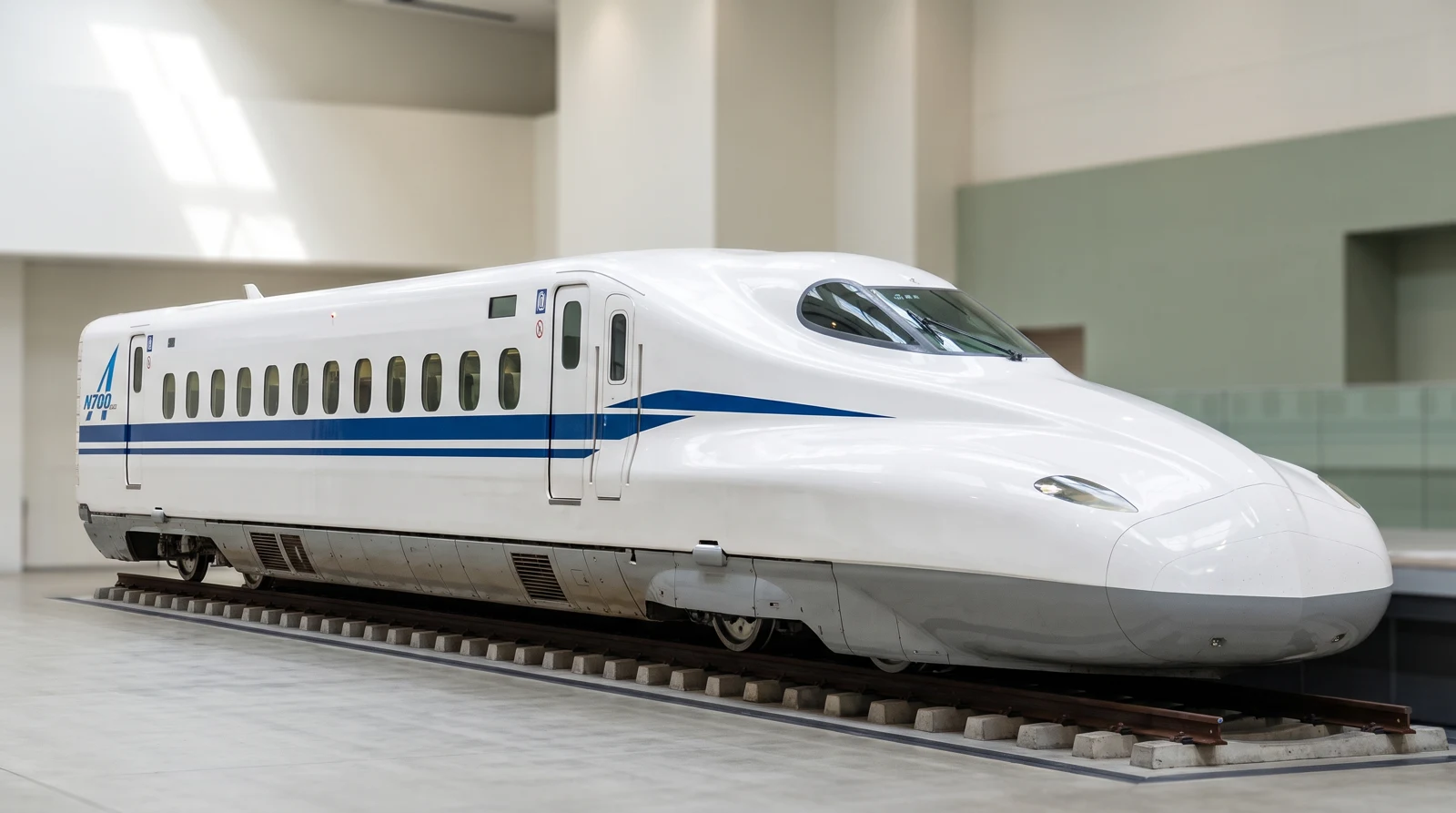 N700S Shinkansen
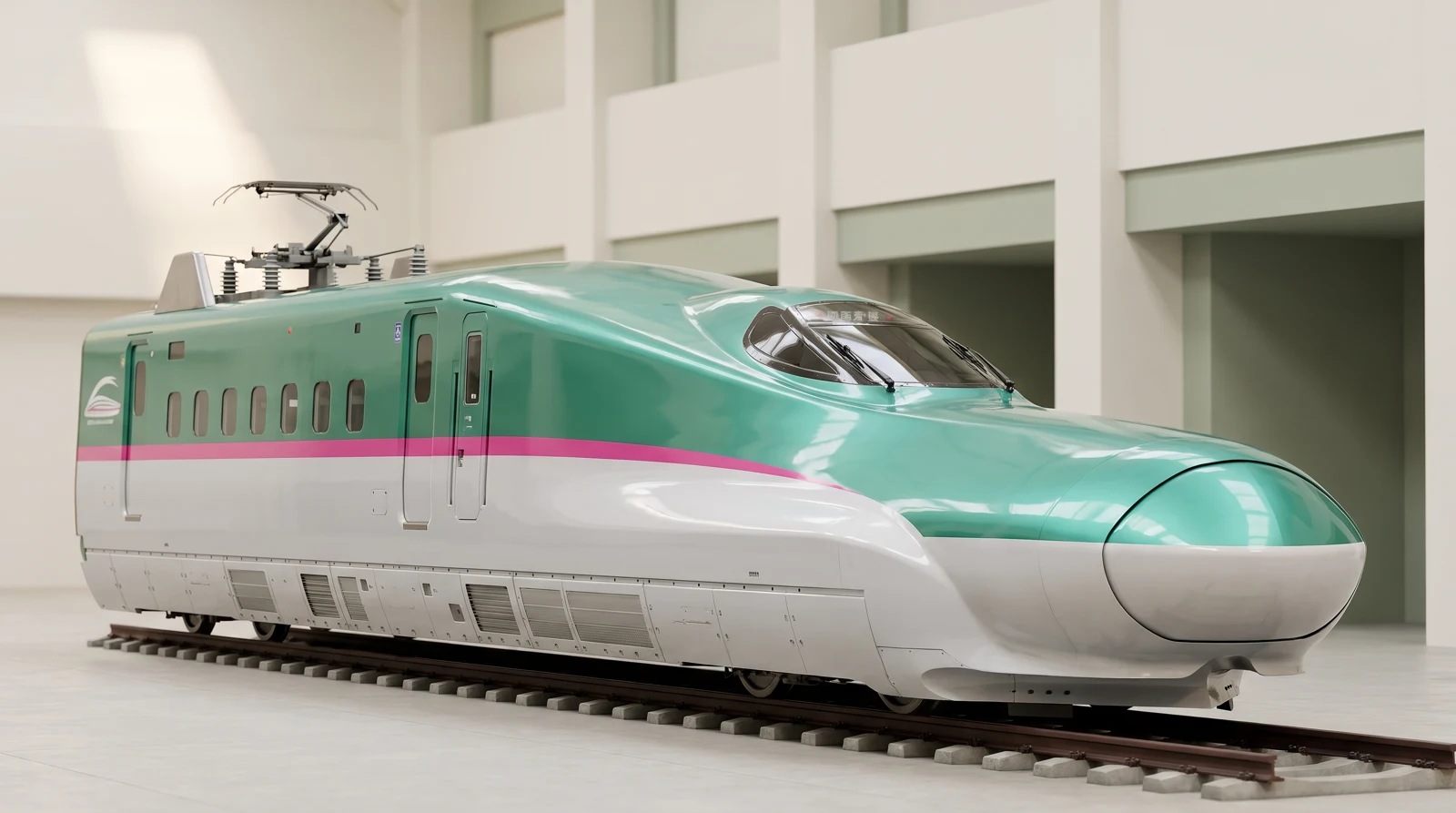 E5 Shinkansen
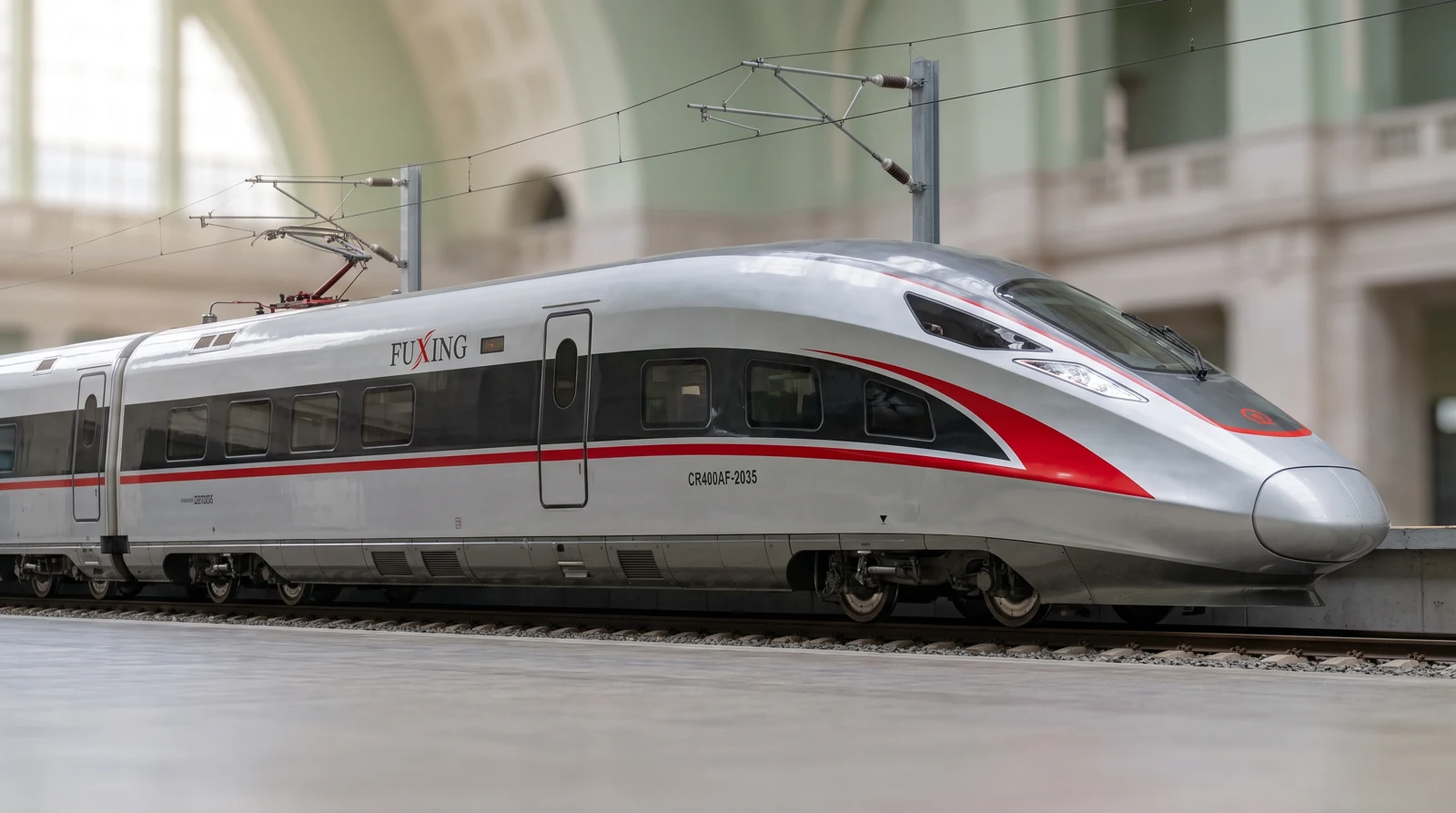 CR400AF Fuxing